- Home
- DNA Testing Types
Types of DNA Testing

There are several types of DNA testing. The following genealogical test types can all be ordered online and use home test kits.
Autosomal DNA Testing
Abbreviated atDNA, autosomal DNA is inherited from both parents. While you get 50% from each parent, which 50% you get is random.
This means you are likely to get uneven amounts from your four grandparents. That is just one reason why the ethnicity reports included with these tests rarely show exactly what you might expect.
Your DNA will be compared with other users who did the same test. Your genetic matches can reflect common ancestors from any branch of your family tree.
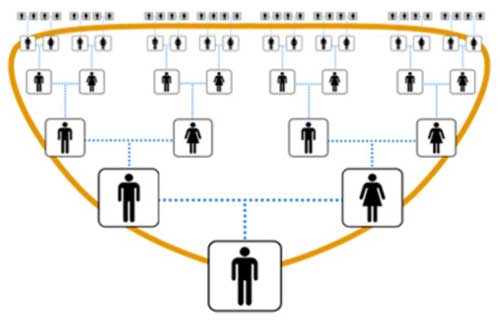
After five generations or so, the DNA from any one ancestor may or may not be detectable.
Second cousins will always share enough DNA to show up as matches. Yet some of your more distant cousins will not share enough to be included in your match list.
Think of autosomal DNA testing as providing a broad but somewhat shallow coverage.
NOTE: Each conception is a unique random event. So your siblings will receive a different mix of your parents' DNA. Compared to your results, they will see some different distant matches and see somewhat different ethnic breakdowns.
When these tests first came out, the price was several hundred dollars. Thanks to improved technology and much greater volume, prices have dropped dramatically. Now autosomal DNA tests cost less than $100 each with frequent sales dropping the price well below that level.
Of all types of DNA testing, autosomal DNA has become the most widely used.
Where To Do Your Autosomal DNA Testing
Only five such tests are worth buying. Each has unique strengths. Click the following links to visit the company websites and see current pricing.
AncestryDNA from Ancestry
Family Finder from Family Tree DNA
23andMe from 23andMe
MyHeritage DNA from MyHeritage
Living DNA from Living DNA
Get Into Every Autosomal DNA Database
I recommend that you get into every database. Genealogists will find many additional matches that expand and confirm your family tree.
Adoptees and others seeking unknown parents and siblings cannot tell in advance which test will uncover the closest or most informative match.
In any case, working from close matches is exponentially easier than starting with distant cousin matches.
TIP: To see what relationships can account for a particular amount of shared DNA, see the Shared cM Table with Odds. You can enter the number of shared centiMorgans (or the shared percentage) to see possible relationships and probabilities for each.
There are other types of DNA testing that can also be valuable for genealogists and adoptees. Read on to learn more.
Y-Chromosome DNA Testing
Of our 23 pairs of chromosomes, one pair determines sex at birth. Men have an X and a Y chromosome, while women have two X chromosomes.
Therefore, Y-DNA tests require a male subject. For women, this can be your brother, your father, a brother of your father, or a son of your father’s brother.
The Y-chromosome passes down from father to son, generation after generation. It follows the direct paternal line as seen in this diagram.
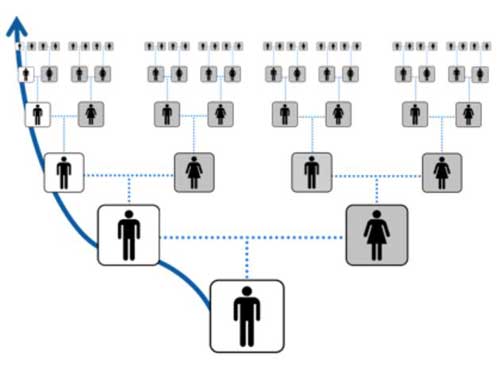
Your direct paternal line is a small part of your overall ancestry. Yet Y-DNA testing can uncover matches from common ancestors who lived hundreds of years ago. Think of it as a deep but narrow look at your family tree.
Mitochondrial DNA Testing
Abbreviated mtDNA, this is different from other types of DNA testing. Mitochondrial DNA is a kind of DNA that mothers pass on to all their children. This means that anyone can do this test.
Since only women pass it on, mitochondrial DNA testing traces your ancestry on the direct maternal line.
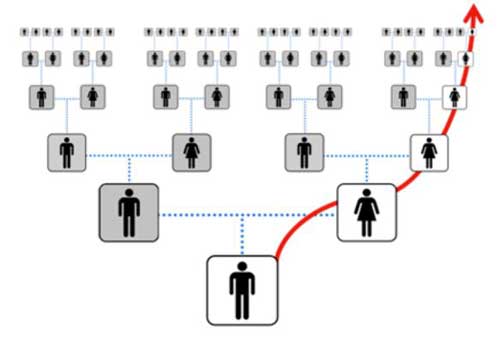
Just like Y-DNA testing, mitochondrial DNA testing is a narrow but deep test of your family tree. Since mtDNA mutates even more slowly that Y-DNA, some of your matches may reflect common female ancestors who lived thousands of years ago.
X-Chromosome DNA Testing
Some autosomal DNA tests also examine the X chromosome, which is found in both males and females. However, the ways in which information about the X-chromosome is reported differ from company to company.
X-DNA has a unique and complex inheritance pattern that makes it useful for ruling out and confirming certain lines, and it is much misunderstood. To learn more, follow these links:
NextGen Sequencing
Autosomal DNA testing has traditionally been done with microarrays, a technology that targets roughly 600,000–700,000 base pairs (bp) of our DNA.
Two companies have started using Next-Generation Sequencing (NGS), which generates much more data. And they are doing it for the same price as before. But they are taking very different approaches to NGS.
Read about these technologies in this blog post on NextGen Sequencing Comes to Genealogy.
Genetic Genealogy Glossary
A glossary of terms is an important resource in any field. My favorite is this glossary by Leah Larkin, The DNA Geek.
NEXT PAGE: The Best DNA Testing Companies
Follow me for DNA news and updates on Facebook, LinkedIn, and Twitter
DNA Blog Posts


-
A Comparison of the New NGS Family Finder with Prior Tests
Oct 16, 26 11:00 AM
Roberta Estes compared her results from her older Family Finder test with those from her new NGS Family Finder test. -
DNA Reuniting Chile’s Stolen Children
Oct 14, 26 11:00 AM
See how this woman is using DNA technology to reunite families separated by illegal adoptions during Chile's Pinochet dictatorship. -
A New Resource for DNA Education
Oct 12, 26 11:00 AM
I recently discovered the Genetic Voyage DNA Academy. It's another great option for learning about genetic genealogy. Check it out.
Do you have a favorite DNA testing resource that's missing from this site?
Use this Submission Form to suggest it for possible inclusion in a future update.
This site is designed for educational purposes only. The author is not engaged in rendering medical or legal advice.
Copyright © 2025 Richard Hill